Fokus and Scope
The journal particularly emphasizes practical laboratory competencies, Good Laboratory Practice (GLP), quality assurance systems, statistical experimental design, and the utilization of advanced analytical instrumentation for qualitative and quantitative chemical analysis.
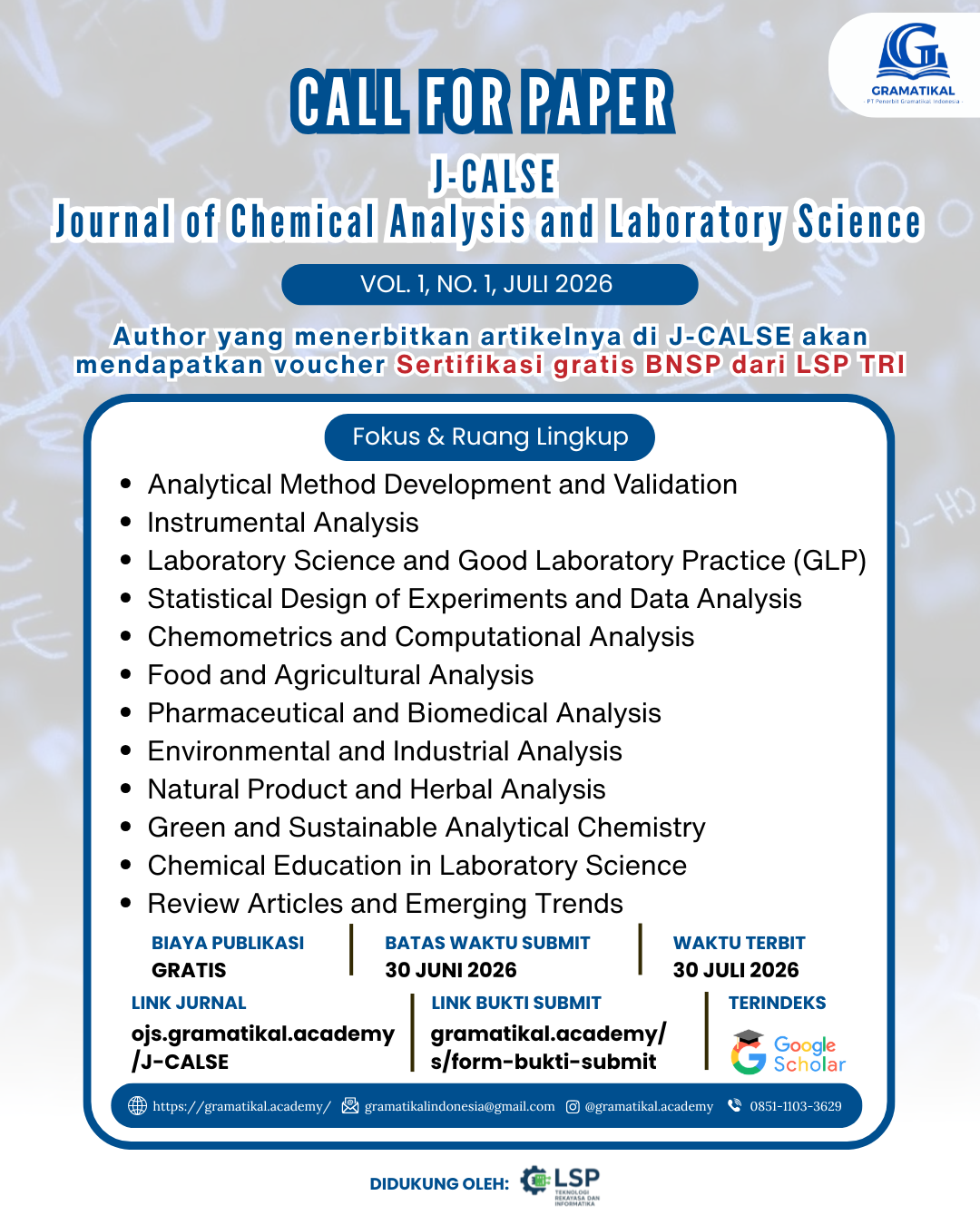
The scope of the journal includes, but is not limited to:
- Analytical Method Development and Validation
Development, optimization, verification, and validation of analytical methods for chemical and biochemical analysis.
- Instrumental Analysis
Applications of modern analytical instruments, including spectrophotometry, chromatography (HPLC, GC, TLC), mass spectrometry, electrochemical analysis, atomic absorption spectroscopy, FTIR, NMR, and related techniques.
- Laboratory Science and Good Laboratory Practice (GLP)
Laboratory management, laboratory safety, quality control, quality assurance, standard operating procedures, calibration, and implementation of GLP principles.
- Statistical Design of Experiments and Data Analysis
Applications of statistical experimental design and data analysis methods, including Response Surface Methodology (RSM), Box–Behnken Design (BBD), Central Composite Design (CCD), factorial design, chemometrics, multivariate analysis, machine learning, and artificial intelligence in analytical chemistry.
- Chemometrics and Computational Analysis
Chemometric modeling, predictive analysis, pattern recognition, calibration models, and computational approaches for analytical data interpretation.
- Food and Agricultural Analysis
Analysis of nutrients, contaminants, additives, pesticides, antioxidants, and bioactive compounds in food and agricultural products.
- Pharmaceutical and Biomedical Analysis
Drug analysis, pharmaceutical quality control, bioanalytical methods, metabolite profiling, and biomarker detection.
- Environmental and Industrial Analysis
Monitoring and determination of pollutants, heavy metals, toxic compounds, and industrial chemical residues in environmental matrices.
- Natural Product and Herbal Analysis
Extraction, characterization, standardization, and chemical profiling of natural products, medicinal plants, and herbal materials.
- Green and Sustainable Analytical Chemistry
Environmentally friendly analytical techniques, green solvents, miniaturized systems, and sustainable laboratory practices.
- Chemical Education in Laboratory Science
Innovations in analytical chemistry education, laboratory-based learning, laboratory competency development, and practical training methodologies in chemical sciences.
- Review Articles and Emerging Trends
Critical review articles, systematic reviews, and emerging developments in analytical chemistry, laboratory science, instrumentation, and experimental design methodologies.
 Article Template